Achieving Problem-Solution Fit
Build and validate your solution using Minimum Viable Products (MVPs). Learn hypothesis-driven experimentation and make data-driven pivot decisions.
The Goal of the TEST Phase
The TEST phase is about achieving Problem/Solution Fit - validating that your proposed solution actually solves the validated customer problem in a way that customers are willing to pay for. You're no longer just talking to customers—you're showing them something tangible.
Why MVPs Matter
- 1.Minimize Waste: MVPs let you test core assumptions with minimal time and resources before full-scale development.
- 2.Maximize Learning: Each MVP is an experiment designed to answer specific questions about your value proposition.
- 3.Reduce Risk: Testing early reveals fatal flaws before you've invested months of development and marketing effort.
- 4.Enable Pivots: Real customer feedback helps you pivot strategically when assumptions prove wrong.
💡 Key Principle:
An MVP is NOT a bad version of your product—it's the minimum version required to test a specific hypothesis. The goal is learning, not perfection. As Eric Ries says: "If you're not embarrassed by your first product release, you launched too late."
Value Proposition Canvas: From Problem to Solution
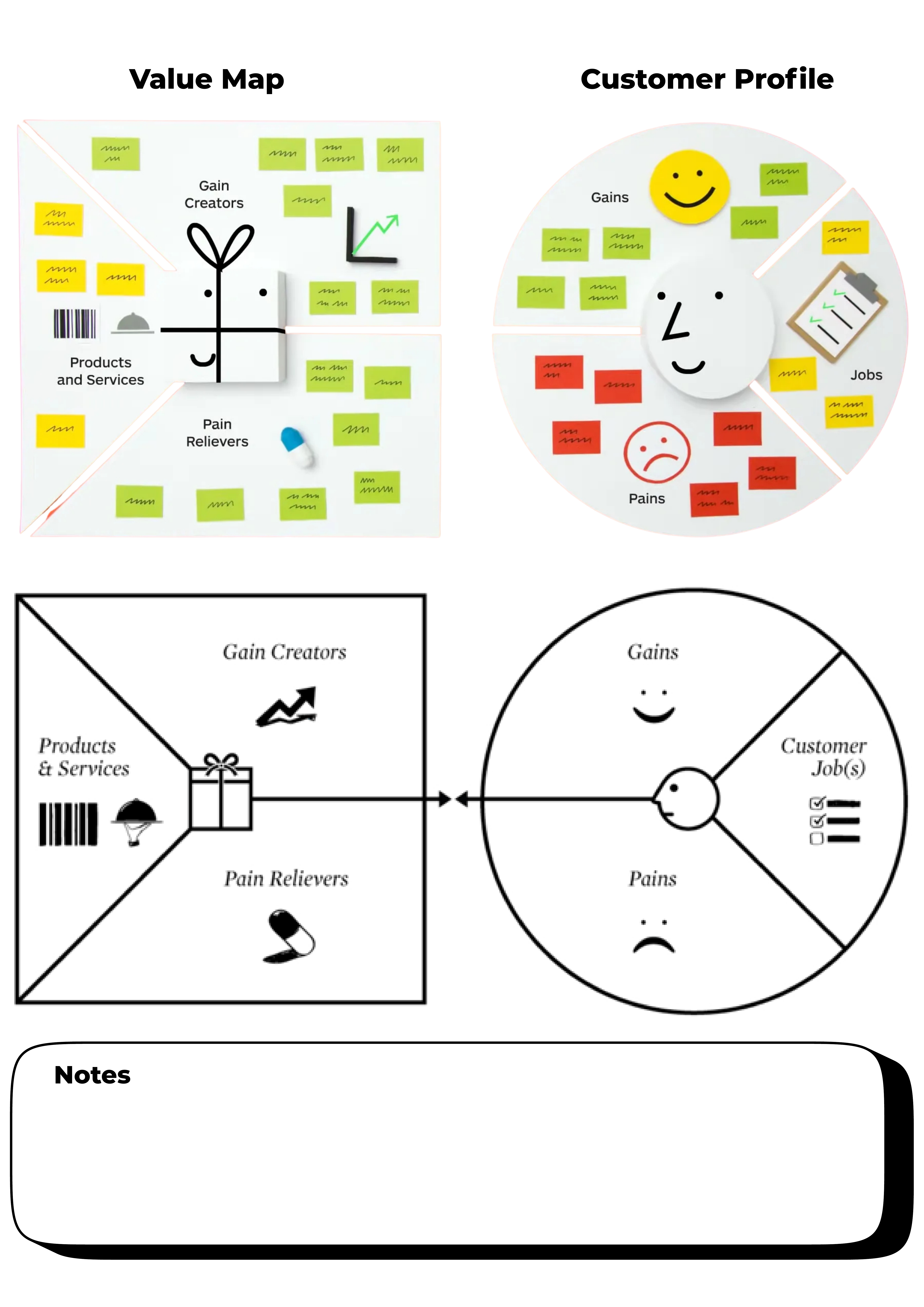
The Value Proposition Canvas, created by Alex Osterwalder (author of Business Model Generation), is your blueprint for achieving Problem/Solution Fit. It systematically maps your solution to customer needs, ensuring you're building something people actually want.
Printable Worksheet Template
This minimalistic template is designed to be printed and filled in as you work through your value proposition. Notice how Customer Jobs connect to Products & Services, Pains to Pain Relievers, and Gains to Gain Creators — ensuring your solution directly addresses customer needs.
Why 42% of Startups Fail
CB Insights found that building products nobody wants is the #1 reason startups fail. The Value Proposition Canvas prevents this by forcing you to match your solution to real, validated customer needs BEFORE you build.
Deep Dive: Customer Profile
1️⃣ Customer Jobs
The functional, social, and emotional tasks customers are trying to complete. Think beyond features - what outcome are they seeking?
Example: Slack
- • Functional Job: "I need to coordinate with my team without email chaos"
- • Social Job: "I want our team to feel connected and collaborative"
- • Emotional Job: "I need to reduce the anxiety of missing important updates"
2️⃣ Customer Pains
Negative outcomes, risks, and obstacles customers face before, during, or after trying to complete their jobs. Rate each pain by severity (extreme → moderate → light).
🔥 Extreme Pains (Must-fix)
Causes significant financial loss, time waste, or emotional stress
Example: "Email inbox is so overwhelming I miss critical client messages"
🟠 Moderate Pains (Should-fix)
Annoying and worth solving, but not deal-breakers
Example: "Searching through email threads to find decisions is tedious"
🟡 Light Pains (Nice-to-fix)
Minor inconveniences that don't significantly impact workflow
Example: "Email notifications can be distracting"
3️⃣ Customer Gains
Outcomes and benefits customers want to achieve. What would make them happy? Rate by importance (essential → expected → desired → unexpected).
Example: Project Management Tool
- • Essential: "Projects delivered on time without constant follow-ups"
- • Expected: "Easy to see who's working on what at a glance"
- • Desired: "Automated reporting to save time on status updates"
- • Unexpected: "Celebrate team wins and boost morale"
Deep Dive: Value Map
This is YOUR side of the canvas - how your product/service addresses the customer profile.
Products & Services
List what you offer - but think in terms of customer jobs, not just features.
Bad: "A mobile app with cloud sync"
Good: "A mobile-first note-taking system that works offline and syncs instantly"
Pain Relievers
Explicitly describe how your product eliminates or reduces customer pains. Focus on extreme pains first - that's where value lives.
Uber's Pain Relievers:
- • Pain: "Can't get a cab in the rain" → Reliever: On-demand availability
- • Pain: "Don't know when cab will arrive" → Reliever: Real-time tracking
- • Pain: "Awkward payment with cash" → Reliever: Automatic payment
- • Pain: "Unsafe or unprofessional drivers" → Reliever: Rating system
Gain Creators
Describe how you create outcomes and benefits customers expect, desire, or would be surprised by.
Notion's Gain Creators:
- • Expected: Organize notes and docs in one place
- • Desired: Beautiful, customizable workspace
- • Unexpected: Build entire workflows without code
Achieving Problem/Solution Fit
Fit occurs when your Value Map explicitly addresses the most important elements of the Customer Profile. Here's how to validate fit:
✅ Every extreme pain has a pain reliever
Don't leave critical problems unsolved
✅ Essential gains are addressed by gain creators
Deliver must-have benefits, not just nice-to-haves
✅ Your products/services map to customer jobs
Customers hire you for a reason - make it explicit
✅ You can rank pains/gains by customer priority
Based on interviews, not assumptions
✅ Customers say 'yes, that's exactly my problem!'
When you show them your canvas, they should nod vigorously
Case Study: Spotify's Value Proposition (Europe)
Customer Profile (2008)
Jobs: Listen to music anytime, discover new artists
Pains: iTunes too expensive, piracy guilt/risk, limited selection
Gains: Instant access, personalized recommendations
Value Map
Product: Streaming music service with freemium model
Pain Relievers: Unlimited music for $10/month, legal streaming
Gain Creators: Discover Weekly (personalized playlists), offline mode
Result: Spotify (Sweden) solved the piracy vs. purchase dilemma and achieved 500M+ users. Their value prop was so strong it converted music pirates into paying customers.
Case Study: Flutterwave's Value Proposition (Africa)
Customer Profile (2016)
Jobs: Accept payments from African and international customers
Pains: Complex integration, multiple currencies, payment failures, fraud
Gains: Reliable payments, simple integration, local payment methods
Value Map
Product: Payment infrastructure for African businesses
Pain Relievers: Single API for 150+ currencies, 99.9% uptime, fraud detection
Gain Creators: 5-minute integration, mobile money support, local expertise
Result: Flutterwave (Nigeria) became Africa's most valuable fintech startup at $3B valuation, processing over $16B in transactions. They solved Africa's fragmented payment infrastructure problem.
Types of MVPs
Not all MVPs are created equal. Choose the right type based on what you need to learn and your available resources.
MVP Types Effectiveness Comparison
Smoke Test MVP
Test demand with a landing page, ads, or pre-orders before building anything.
Concierge MVP
Manually deliver your service to understand customer needs deeply.
Wizard of Oz MVP
Users think they're using an automated product, but you're manually fulfilling requests behind the scenes.
Prototype MVP
A working but limited version of your product with core functionality only.
Regional MVP Success Stories
MVPs look different in different contexts. Here's how startups from Africa and Europe adapted MVP principles to their unique market conditions and constraints.
🇳🇬 M-Kopa Solar (Kenya) - Hardware Concierge MVP
🇸🇪 Klarna (Sweden) - Prototype MVP for Regional Payment Gap
🇰🇪 Twiga Foods (Kenya) - SMS-Based Smoke Test
🇳🇱 Adyen (Netherlands) - Wizard of Oz Payment Processing
Key Insight: Context Matters for MVPs
African MVP Patterns:
- • Start with SMS/USSD before building apps (basic phone penetration)
- • Mobile money integration is often the killer feature
- • Manual fulfillment longer due to infrastructure gaps
- • Pay-as-you-go models resonate (limited upfront capital)
- • Focus on last-mile delivery/access problems
European MVP Patterns:
- • Multi-country/currency from day one (EU fragmentation)
- • GDPR compliance even in early MVP tests
- • Strong skepticism of US tech → local alternatives thrive
- • Payment preferences vary by country (SEPA, iDEAL, Klarna)
- • Regulatory navigation is part of the MVP learning
Build-Measure-Learn Loop
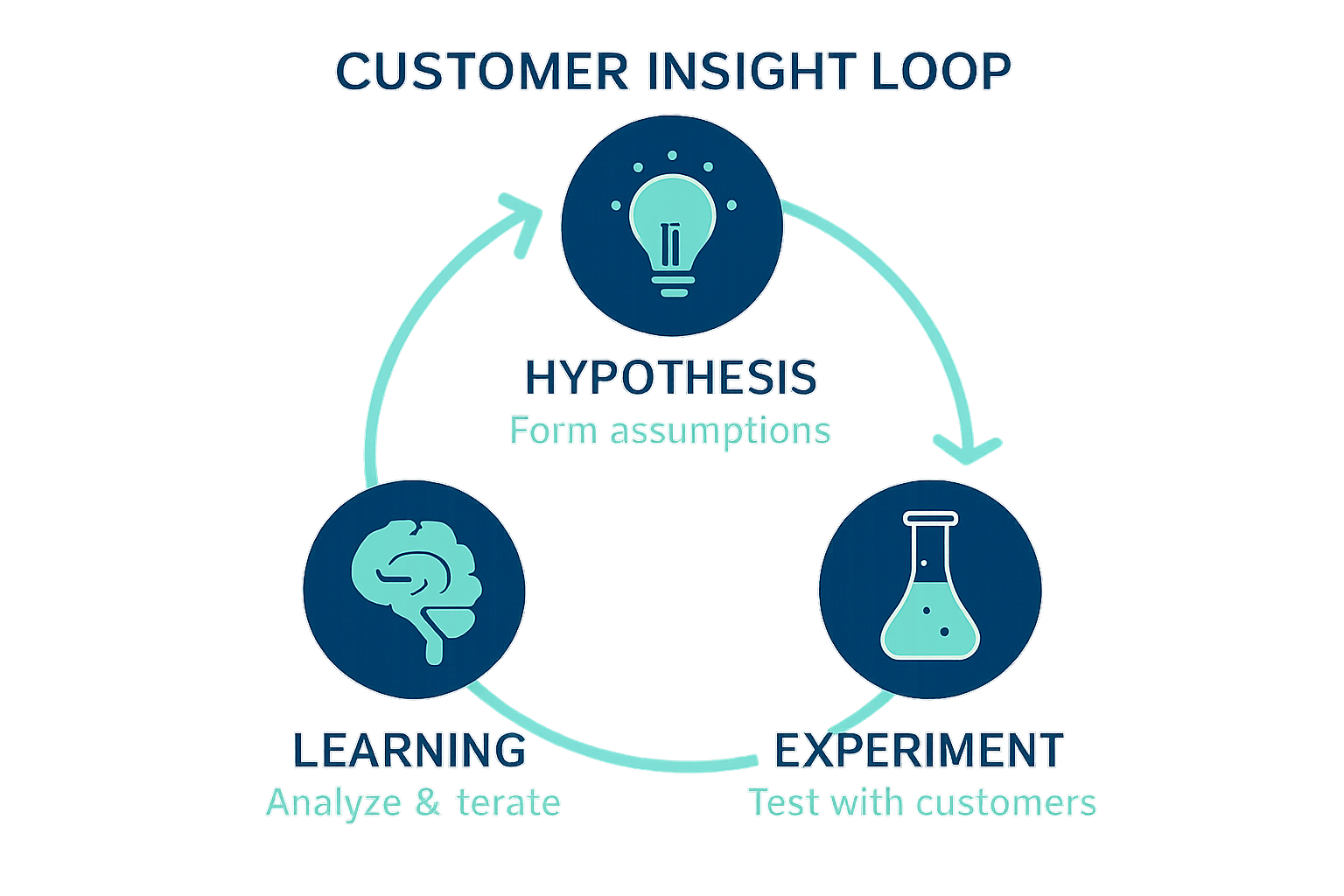
Eric Ries's Build-Measure-Learn loop is the core of Lean Startup methodology. The goal is to minimize the time through this feedback loop and maximize learning per dollar spent.
BUILD
Build the simplest possible version to test your hypothesis
MEASURE
Collect data on how customers actually behave with your MVP
LEARN
Decide whether to pivot or persevere based on validated learning
⚠️ Common Mistake
Many entrepreneurs focus too much on Build and not enough on Measure and Learn. The key insight is working backwards from learning goals to determine what to build.
📝 Update Your Business Model Canvas
After building and testing your MVP, it's time to UPDATE your Business Model Canvas with validation data and real customer feedback—refining your assumptions into proven facts.
Building Blocks to Update After TEST:
- 1.Value Propositions: Based on MVP feedback, which features do customers actually value? Which solve the core problem most effectively? Update to reflect validated value, not assumed value.
- 2.Revenue Streams: What pricing models did you test? Which ones resonated? Update with validated willingness-to-pay data and pricing experiments.
- 3.Channels: Which acquisition channels brought your MVP users? What worked and what didn't? Update based on actual conversion data, not guesses.
- 4.Key Activities & Resources: What did building and testing your MVP reveal about what you actually need to deliver value? Update based on real development and operational learnings.
- 5.Cost Structure: What are the real costs of building and delivering your solution? Update with actual MVP development and testing costs.
💡 From Hypothesis to Evidence:
This is where your BMC transforms from a set of guesses to a data-backed business model. Update your canvas with metrics, customer quotes, and experiment results. Version it (e.g., "V3.0 - Post MVP Testing") and document your pivot decisions if you made any.
Test Your Knowledge
TEST Phase Quiz
What is the main goal of the TEST phase?
Your Progress
MVP Planning & Testing Framework
A comprehensive guide for planning, building, and testing your Minimum Viable Product using hypothesis-driven experimentation.
Worksheet Preview:
MVP Hypothesis Definition
- □Define your core value proposition hypothesis
- □Identify key assumptions to test
- □Set measurable success criteria
- ... and 2 more items
MVP Design & Build
- □Create user flow for core functionality
- □Design minimum feature set (remove nice-to-haves)
- □Build with focus on learning, not perfection
- ... and 2 more items
... and 3 more sections
Video Resources

Value Proposition Canvas Explained
Learn how to use the Value Proposition Canvas to achieve problem-solution fit
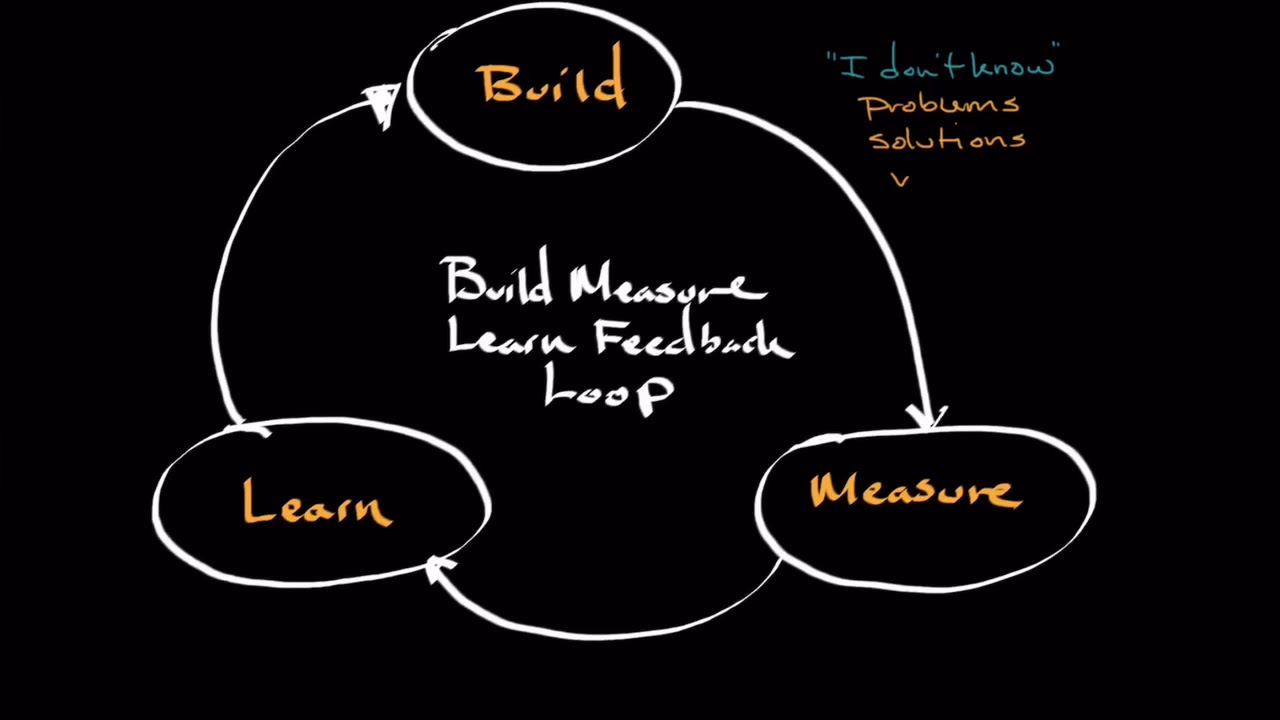
Build-Measure-Learn Loop
Eric Ries explains the core Lean Startup methodology and rapid experimentation

MVP Strategies & Case Studies
Real examples of successful MVP approaches from top startups
🎯 Key Takeaways
- Problem-solution fit means validating that your solution effectively solves the customer problem you identified
- Build MVPs iteratively—start with landing pages or prototypes before committing to full product development
- Use the Build-Measure-Learn cycle to validate hypotheses with real customer feedback and data
- Update your BMC's Value Propositions, Channels, and Revenue Streams based on MVP testing results
- Don't be afraid to pivot—most successful startups changed their initial idea based on customer feedback
📋 What's Next?
With problem-solution fit validated, you're ready to move to the EXECUTE phase. You'll focus on achieving product-market fit, scaling your operations, optimizing your unit economics, and building sustainable growth engines. Continue refining your BMC as you scale!