Achieving Customer-Problem Fit
Discover real customer problems worth solving through systematic research and validation. Master customer segments, immersion techniques, and the Jobs-to-be-Done framework.
Why Customer Discovery Comes Before Building
The EXPLORE phase is where you validate that the problem you want to solve actually exists and is painful enough for customers to pay for a solution. Most startups fail because they skip this step and build products based on assumptions rather than evidence.
The Goal of Customer Discovery
- 1.Identify Your Customer Segments: Who has this problem? Not everyone is your customer.
- 2.Validate the Problem: Is this problem real, frequent, and painful enough to solve?
- 3.Understand Current Solutions: What workarounds do customers use today? Why aren't they satisfied?
- 4.Uncover Hidden Needs: What do customers really want vs. what they say they want?
💡 Key Principle:
Customer discovery is not about validating your idea—it's about learning the truth. You're looking for reasons NOT to build your solution, not confirmation bias. The best founders approach discovery with humility and curiosity, ready to pivot based on what they learn.
Customer Development Process
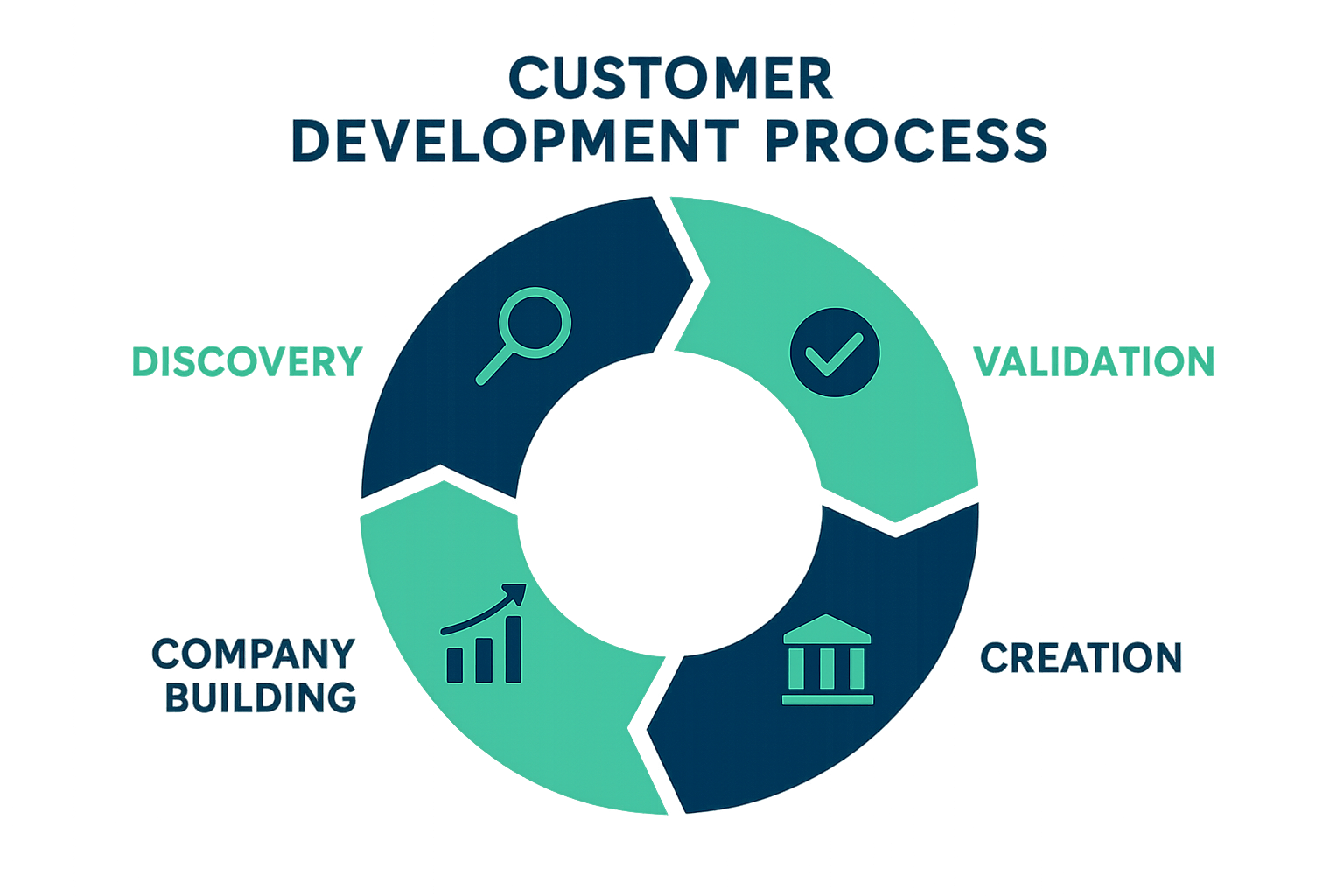
Steve Blank's Customer Development process begins with Customer Discovery - the systematic approach to understanding your customers and their problems before building solutions. This methodology revolutionized how startups approach product development by prioritizing customer learning over assumptions.
Key Principle
"There are no facts inside the building, so get outside!" - Steve Blank. Customer discovery happens through direct interaction with potential customers, not internal assumptions.
The Four Stages of Customer Development
1. Customer Discovery
Test whether your understanding of the customer problem is correct. Document your hypotheses and get out of the building to validate them with real customers.
2. Customer Validation
Prove that you've built something people want. Test your sales process and verify that customers will actually pay for your solution.
3. Customer Creation
Scale customer acquisition through repeatable marketing and sales processes. Build awareness and drive demand for your product.
4. Company Building
Transition from a startup to an established company with departments, processes, and scalable operations.
Why Customer Discovery Matters
- Reduces Risk: 42% of startups fail because they build products nobody wants. Customer discovery validates demand before you invest heavily in development.
- Saves Resources: Building the wrong product can cost months of time and hundreds of thousands of dollars. Early customer feedback prevents costly mistakes.
- Uncovers Hidden Insights: Customers often can't articulate what they need, but observation and skilled questioning reveal valuable insights.
- Builds Customer Relationships: Early customer conversations create advocates who become beta testers, case studies, and evangelists.
Mastering Customer Interviews
Customer interviews are the cornerstone of customer discovery. The goal isn't to validate your idea - it's to learn the truth about your customers' problems, behaviors, and motivations, even if that truth contradicts your assumptions.
⚠️ The #1 Interview Mistake
Most founders pitch their solution instead of learning about the problem. Remember: You're a scientist gathering data, not a salesperson. Save pitching for customer validation phase.
The Mom Test: Interview Questions That Don't Lie
Rob Fitzpatrick's "The Mom Test" teaches us to ask questions that even your mom can't lie to you about. The trick is asking about specific past behaviors rather than hypothetical futures or opinions.
❌ Bad Questions
- "Would you use this app?"
- "Do you think this is a good idea?"
- "Would you pay $50/month for this?"
- "What features should we build?"
- "Don't you hate when [problem] happens?"
These questions invite polite lies and false positives
✅ Good Questions
- "Tell me about the last time you [encountered problem]"
- "What are you currently using to solve this?"
- "How much does [current solution] cost you?"
- "Walk me through your process for [task]"
- "What happened when you tried to [solve problem]?"
These questions reveal actual behavior and concrete facts
The 5-Step Interview Framework
1. Welcome (2 mins)
Set the context and build rapport. Explain you're doing research (not selling) and ask permission to record.
💡 Pro Tip: Start with easy questions about their role to help them relax.
2. Context (5-10 mins)
Understand their world, daily workflows, and responsibilities. Who they work with, what tools they use, what success looks like.
💡 Pro Tip: Ask them to 'walk you through' their typical day/week.
3. Problem Deep-Dive (15-20 mins)
Explore specific problem areas with detailed follow-ups. Focus on their last 3-5 experiences with the problem.
💡 Pro Tip: Use 'Tell me more about that' and 'Why?' to dig deeper.
4. Current Solutions (10-15 mins)
Understand what they're doing today, what works, what doesn't, and why they chose their current approach.
💡 Pro Tip: Ask about money, time, and effort they currently invest.
5. Wrap-Up (3-5 mins)
Ask who else you should talk to, thank them sincerely, and request a follow-up if needed.
💡 Pro Tip: The best question: 'What should I have asked that I didn't?'
Real Example: Dropbox's Customer Discovery
Before building Dropbox, Drew Houston conducted extensive customer interviews with people who struggled with file sharing. Key insights emerged:
- People weren't looking for "cloud storage" - they needed to access files across devices without thinking about it
- Email attachments and USB drives were the painful status quo - people lost hours per week
- Technical users were already using rsync and FTP - validation that the problem was worth solving
Result: Houston focused on invisible synchronization rather than feature-packed storage, leading to Dropbox's legendary "it just works" experience.
Finding & Recruiting Interview Subjects
"I don't know how to find customers to interview" is a common excuse. The truth? If you can't find 10 people to talk to, you probably don't have a viable business. Here's how to find them:
Warm Outreach Channels
Your Network
Friends, former colleagues, LinkedIn connections
Second-Degree
Ask for introductions: 'Who do you know that...?'
Industry Events
Conferences, meetups, trade shows
Online Communities
Reddit, Facebook groups, Discord servers, forums
Cold Outreach Channels
Target-specific outreach with personalized messages
Twitter/X
Engage with thought leaders in your space
Direct outreach to potential customers
Landing Pages
Offer incentives for interview sign-ups
Sample Interview Request Email
Subject: Quick research question about [THEIR PROBLEM]
Hi [NAME],
I noticed you're [CONTEXT ABOUT THEM]. I'm researching [PROBLEM AREA] and would love to learn about your experience with [SPECIFIC CHALLENGE].
Would you have 20 minutes this week for a quick call? I'm not selling anything - just trying to understand the problem better. Happy to buy you coffee or send you a $25 Amazon gift card as a thank you.
Thanks!
[YOUR NAME]
Key elements: Personalized, specific about the problem (not your solution), clear time commitment, and small incentive to show respect for their time.
✅ Interview Recruitment Tips
- Aim for 20-50 interviews in the discovery phase
- Offer $25-50 gift cards or donate to their favorite charity
- Make it easy: offer specific time slots, use Calendly
- Build in buffer time - expect 30-50% no-shows
Understanding Customer Segments
Not all customers are created equal. Understanding the Technology Adoption Lifecycle (based on Everett Rogers' Diffusion of Innovations and popularized by Geoffrey Moore in "Crossing the Chasm") helps you prioritize which customers to target first and how to approach each segment differently.
Customer Segment Distribution
The Chasm: Your First Major Challenge
Geoffrey Moore identified a crucial gap between Early Adopters and the Early Majority (Pragmatists). Most startups fail to "cross the chasm" because they try to scale too early without product-market fit. Focus on dominating a narrow niche with Early Adopters first.
Detailed Segment Analysis
🎯 Innovators (2.5%)
Technology enthusiasts who want to try new things first
Characteristics: Risk-tolerant, self-sufficient, technically sophisticated
Motivation: Being first, exploring new technology
Challenge: Don't represent mainstream market, often unreliable for feedback
⭐ Early Adopters (13.5%)
Visionaries seeking competitive advantage from new solutions
Characteristics: Quick decision makers, high pain tolerance, strategic thinkers
Motivation: Gaining strategic advantage, solving pressing problems
Your Target: These are your ideal first customers!
💼 Early Majority (34%)
Pragmatists who want proven solutions with references
Characteristics: Risk-averse, need social proof, want complete solutions
Motivation: Proven ROI, incremental improvements, peer validation
Challenge: Won't buy without references from similar companies
🐌 Late Majority & Laggards (50%)
Conservatives and skeptics who resist change
Characteristics: Highly risk-averse, need hand-holding, price-sensitive
Motivation: Forced by market pressure, commodity pricing
Strategy: Ignore them until you dominate your market
How to Identify Early Adopters
Look for these 5 qualification criteria:
1. They have the problem NOW
Not hypothetically - they're actively experiencing pain today
Example: "We're losing $10K/month because of this issue"
2. They're aware they have the problem
They've already tried to solve it or searched for solutions
Example: "We've tried 3 different tools but nothing works well"
3. They've assembled a budget
Money is allocated or they have authority to spend
Example: "We have $500/month budgeted for this solution"
4. They've attempted a DIY solution
They've tried building something themselves or using workarounds
Example: "We're using 5 Google Sheets and manual processes"
5. They have buying authority
They can make the decision without 10 layers of approval
Example: "I can approve purchases under $1000/month myself"
Case Study: Superhuman's Early Adopter Focus
Superhuman (email client) spent 2 years in invite-only beta, focusing exclusively on early adopters. Their criteria:
- Send/receive 100+ emails daily (high frequency users)
- Willing to pay $30/month for better email (budget + willingness)
- Frustrated with current email clients (acute problem)
- Value speed and efficiency over everything (specific outcome)
Result: Superhuman achieved 58% "very disappointed" PMF score (Sean Ellis test) and $20M+ ARR before expanding beyond early adopters. They didn't chase growth - they chased product love.
Jobs-to-be-Done Framework
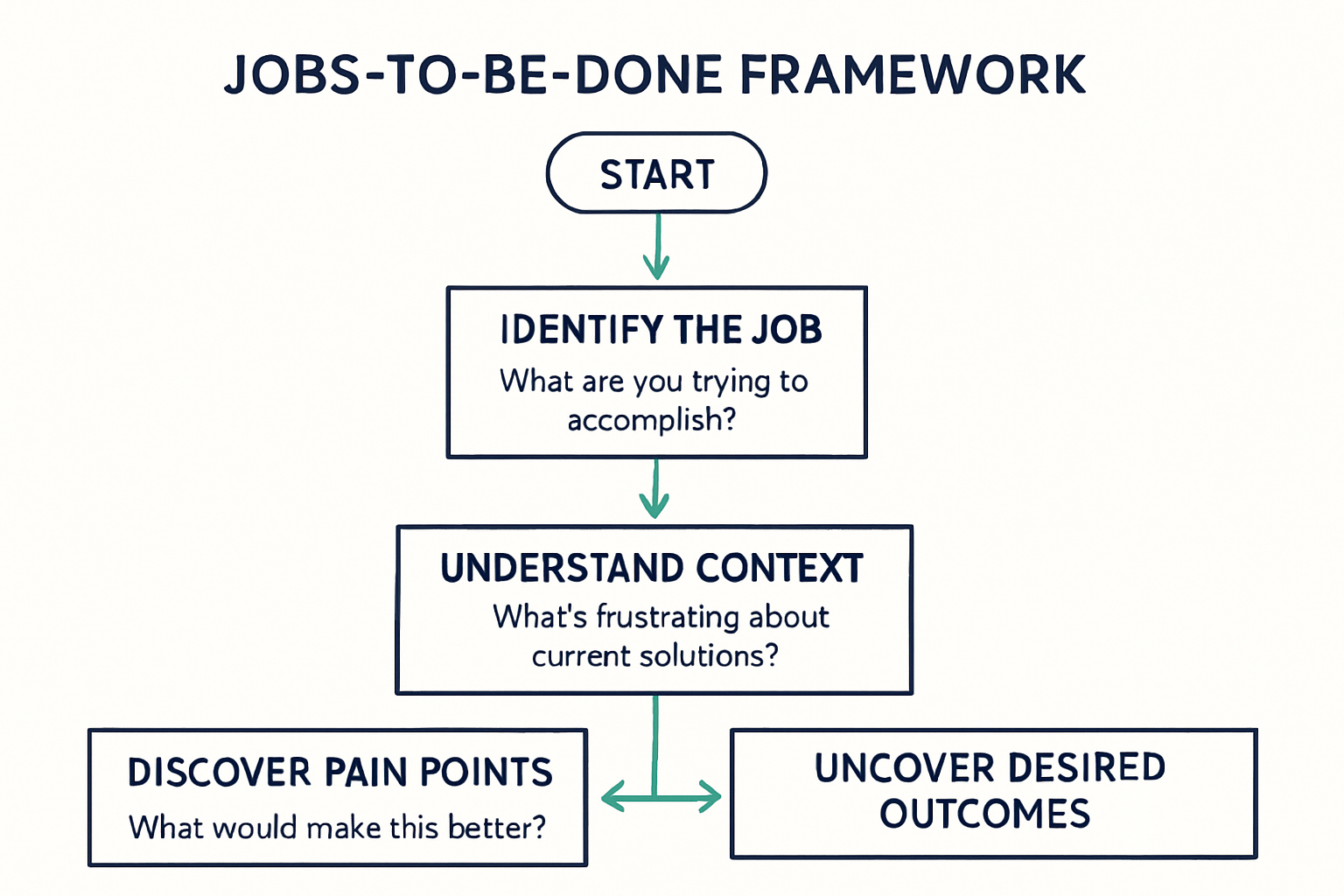
The Jobs-to-be-Done (JTBD) framework, pioneered by Clayton Christensen (Harvard Business School), revolutionizes how we understand customer needs. Instead of asking "What do customers want?", JTBD asks "What progress are customers trying to make in their lives?" Customers don't buy products - they "hire" solutions to get jobs done.
The Milkshake Story
Clayton Christensen's famous research into fast-food milkshakes revealed that morning customers weren't buying milkshakes for taste - they were hiring them to make their boring commute more interesting and keep hunger at bay until lunch. The "job" was entertainment + satiation, not refreshment. This insight led to thicker, fruitier shakes that took longer to consume - perfect for the morning commute.
The Three Dimensions of Jobs
1. Functional Job
The practical task to accomplish
Examples:
- • Get from A to B safely
- • Share files with team
- • Track expenses
- • Learn a new skill
2. Emotional Job
How they want to feel
Examples:
- • Feel confident/capable
- • Reduce anxiety/stress
- • Feel professional
- • Avoid embarrassment
3. Social Job
How they want to be perceived
Examples:
- • Be seen as innovative
- • Show care for family
- • Belong to a community
- • Demonstrate expertise
💡 Breakthrough products typically excel at all three dimensions simultaneously
The JTBD Interview Script
Instead of asking "What features do you want?", use this proven script to uncover real jobs:
First Thought
"When did you first realize you needed something like [solution category]?"
→ Identifies the triggering event and context
Passive Looking
"What did you do when you first had that thought?"
→ Reveals initial problem-solving attempts
Active Looking
"Where did you go to find solutions? What did you try?"
→ Uncovers search behavior and evaluation criteria
Deciding
"What made you choose [their current solution]? What almost stopped you?"
→ Exposes decision drivers and anxiety factors
First Use
"What happened when you first used it? Did it work as expected?"
→ Identifies onboarding friction and aha moments
Ongoing Use
"How has your usage changed over time? What would make you switch?"
→ Reveals evolving needs and switching triggers
Real Example: Airbnb's Job Discovery
Airbnb discovered through JTBD interviews that travelers weren't just hiring them for "accommodation":
Functional Job: "I need an affordable place to stay that feels like home"
Emotional Job: "I want to feel like a local, not a tourist - experience authentic culture"
Social Job: "I want to show my friends I'm a savvy, adventurous traveler"
Key Insight: Hotels were competing on amenities (pool, gym, breakfast), but Airbnb competed on authenticity and local experience. Different job = different competitive set.
Another Example: Slack's Surprising Job
Slack discovered that teams weren't hiring them primarily for "team communication" - they were hiring Slack to solve these deeper jobs:
- Functional: "Reduce the noise from email overload while staying informed"
- Emotional: "Feel connected to my team and reduce loneliness (especially remote workers)"
- Social: "Show my company we're modern and forward-thinking"
This is why Slack focused heavily on emoji reactions, GIFs, and channel culture - these addressed the emotional and social jobs, not just the functional communication job.
JTBD Exercise: Competing Against "Non-Consumption"
Your biggest competitor isn't another product - it's customers doing nothing at all. Understand what "hiring nothing" looks like:
Question 1: What are customers doing TODAY to get this job done?
→ Manual processes, spreadsheets, workarounds, ignoring the problem
Question 2: What forces are holding them back from adopting a solution?
→ Cost, learning curve, switching costs, habit, "not broken enough"
Question 3: What would need to change for them to try something new?
→ Pain threshold, new regulation, team growth, competitor pressure
Synthesizing & Acting on Interview Data
Conducting interviews is only half the battle. The real magic happens when you systematically analyze patterns, extract insights, and turn them into actionable decisions. Here's your complete synthesis framework:
The 4-Step Synthesis Process
Step 1: Transcribe & Tag (Within 24 Hours)
Don't trust your memory. Document everything while it's fresh.
- Write down key quotes verbatim (use Otter.ai, Fireflies, or Rev)
- Tag insights: Problems, Solutions, Workarounds, Emotions, Costs, Buying Process
- Rate problem intensity: 1-10 scale based on their language and emotion
Step 2: Pattern Recognition (After 10-15 Interviews)
Look for recurring themes across interviews.
- Create an affinity diagram: group similar problems, emotions, and quotes
- Count frequency: How many people mentioned each problem?
- Assess urgency: Which problems cause the most pain/cost?
Step 3: Problem Prioritization
Not all problems are worth solving. Use this scoring matrix:
Problem Score = (Frequency × Intensity × Willingness to Pay) / Difficulty to Solve
- • Frequency: % of interviewees who have this problem
- • Intensity: Average pain rating (1-10)
- • Willingness to Pay: Do they have budget allocated?
- • Difficulty: How hard is it to solve technically?
Step 4: Hypothesis Refinement
Update your assumptions based on evidence.
- Rewrite your problem statement with specific customer language
- Narrow your target customer to the segment with highest pain
- Decide: Pivot, Persevere, or Keep Exploring?
⚠️ Red Flags: When to Pivot or Stop
- ❌Less than 40% of interviewees have the problem you're trying to solve
- ❌Average problem intensity is below 6/10 - not painful enough
- ❌No one has budget or willingness to pay for a solution
- ❌They say they want it, but when you dig deeper, they're not actively looking for solutions
- ❌Can't find 10 people willing to talk to you about the problem
✅ Green Lights: Signals to Move Forward
- ✓60%+ of interviewees experience the problem frequently (weekly or more)
- ✓Average problem intensity is 7+ / 10
- ✓They're currently spending time/money on imperfect workarounds
- ✓They ask YOU for updates or when they can try your solution
- ✓You can clearly articulate the problem in the customer's own words
📝 Update Your Business Model Canvas
Now that you've completed customer discovery and validated your problem, it's time to REFINE your Business Model Canvas with real insights—not assumptions.
Building Blocks to Update After EXPLORE:
- 1.Customer Segments: Refine your segments based on who actually experiences the problem most intensely. You may discover new segments or eliminate ones that don't care about the problem.
- 2.Value Propositions: Update based on the specific pains, gains, and jobs-to-be-done you discovered in interviews. Make sure your value prop addresses the real problem, not your assumed one.
- 3.Channels: Where do your customers currently look for solutions? How do they prefer to learn about new products? Update your channel strategy based on their actual behavior.
- 4.Customer Relationships: What level of support and engagement do they expect? Update based on interview feedback about how they want to interact with solutions.
⚠️ Critical Reminder:
Your BMC is a living document. Version your updates (e.g., "V2.0 - Post Explore"). Keep track of what changed and why—this shows investors and your team that you're learning and adapting based on evidence.
Test Your Knowledge
EXPLORE Phase Quiz
What is the primary goal of the EXPLORE phase?
Your Progress
Customer Discovery Interview Guide
A comprehensive framework for conducting effective customer interviews to validate problems and uncover insights.
Worksheet Preview:
Pre-Interview Preparation
- □Define your key assumptions to test
- □Identify your target customer segment
- □Research the interviewee's background
- ... and 2 more items
Opening Questions (5-10 minutes)
- □Tell me about your role and daily responsibilities
- □Walk me through your typical day/week
- □What are your biggest challenges right now?
- ... and 1 more items
... and 3 more sections
Video Resources

Customer Development Process
Learn Steve Blank's systematic approach to customer discovery and validation
Jobs-to-be-Done Framework
Understanding how customers 'hire' products to get jobs done in their lives
🎯 Key Takeaways
- Customer-problem fit means deeply understanding who your customers are and what problems truly matter to them
- Get out of the building! Direct customer interviews are the most effective way to discover real problems
- Use the Jobs-to-be-Done framework to understand functional, social, and emotional needs
- Update your BMC's Customer Segments and Value Propositions based on insights from customer discovery
- Avoid the trap of building solutions before validating problems—this is the #1 cause of startup failure
📋 What's Next?
Now that you've identified and validated a real customer problem, it's time to move to the TEST phase. You'll build Minimum Viable Products (MVPs) to test potential solutions, validate your value propositions, and work toward achieving problem-solution fit. Remember to continuously refine your BMC as you learn!