The Business Model Canvas
Your Single Source of Truth Throughout the Entire Course
Understanding Business Model Design
Business model design is the process of systematically defining how your startup will create, deliver, and capture value. Unlike product design (which focuses on features) or UX design (which focuses on user experience), business model design focuses on the fundamental logic of how your business will work and sustain itself.
Why Business Model Design Matters
Many startups fail not because they lack a great product, but because they lack a viable business model. You might solve a real problem with an elegant solution, but if you can't figure out how to reach customers cost-effectively, monetize your offering, or operate sustainably, your startup won't survive. Business model design is the bridge between a compelling idea and a sustainable business.
Why the BMC is the Ideal Tool for Business Model Design
- 1.Visual & Holistic: Traditional business plans are text-heavy and linear, making it hard to see connections. The BMC presents all 9 components on one page, revealing how changes in one area (e.g., changing your customer segment) impact others (e.g., channels, revenue streams).
- 2.Hypothesis-Driven: Each block is essentially a set of assumptions you need to validate. The BMC makes your assumptions explicit, forcing you to test them systematically rather than treating them as facts.
- 3.Iterative by Design: Unlike rigid business plans, the BMC is designed to be sketched, printed, posted on walls, and updated with sticky notes. This physical malleability encourages iteration and experimentation—the essence of startup methodology.
- 4.Strategic Alignment: The BMC's structure ensures all team members understand the complete business model, not just their individual functions. This shared understanding is critical for coordinated decision-making and pivots.
💡 Key Insight:
Business model design is not a one-time planning exercise—it's an ongoing design challenge. The BMC's 9 building blocks provide a structured framework that transforms complex business logic into a clear, testable format. This is why it has become the global standard for startups, from Nairobi to Amsterdam to Silicon Valley.
The 9 Building Blocks
A visual representation of how your business creates, delivers, and captures value
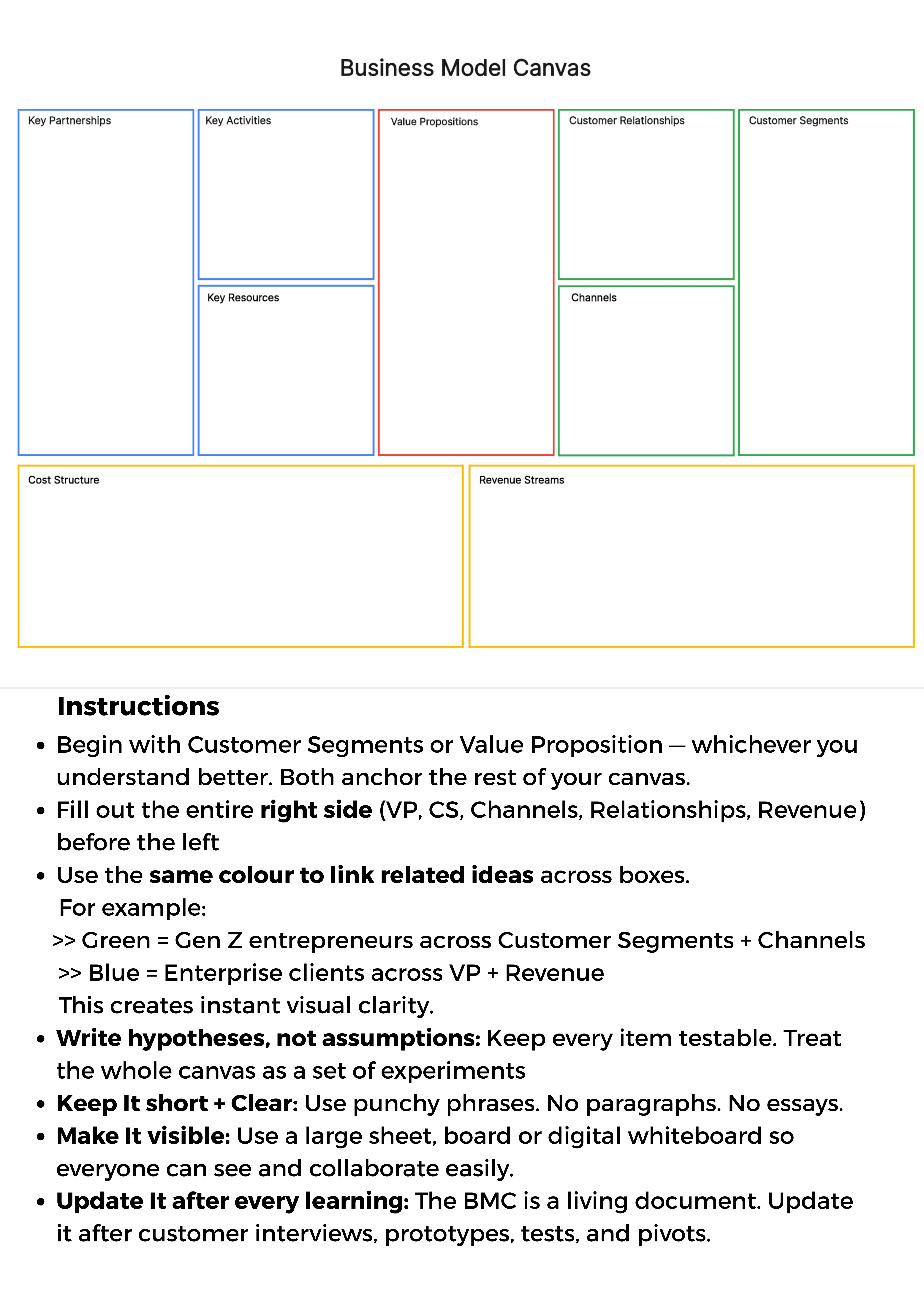
The Business Model Canvas provides a holistic view of your business on a single page
What is the Business Model Canvas?
The Business Model Canvas, created by Alexander Osterwalder and Yves Pigneur in their book Business Model Generation, is a strategic management template for developing new business models or documenting existing ones.
Unlike traditional 50-page business plans that take weeks to write and are often outdated before completion, the BMC provides a visual, one-page snapshot of your entire business model that can be quickly iterated based on new learnings.
Why Use the BMC?
- Visual & Intuitive: See your entire business model at a glance
- Fast Iteration: Quickly test and update assumptions
- Shared Language: Align your team around key business elements
- Evidence-Based: Update based on real customer feedback and data
- Investor Communication: Clearly articulate your business to stakeholders
Understanding the 9 Building Blocks
1. Customer Segments
WHO you are creating value for
Customer Segments define the different groups of people or organizations your enterprise aims to reach and serve. Customers are the heart of any business model.
Key Questions:
- • For whom are we creating value?
- • Who are our most important customers?
- • Are we serving mass market, niche market, segmented, diversified, or multi-sided platforms?
Example - Amazon (USA):
Customer Segments: Online shoppers seeking convenience (B2C), Third-party sellers needing marketplace access (B2B), Amazon Prime members wanting fast delivery and streaming, and AWS customers requiring cloud infrastructure (B2B). Amazon operates multiple interconnected platforms serving diverse customer segments.
Example - Spotify (Sweden/Europe):
Customer Segments: Free users (ad-supported), Premium subscribers (ad-free), Family plan users, Student subscribers, and Artists/content creators. Spotify serves a two-sided market connecting listeners with content creators.
2. Value Propositions
WHAT value you deliver to customers
The Value Proposition describes the bundle of products and services that create value for a specific Customer Segment. It's the reason why customers choose your company over competitors.
Key Questions:
- • What value do we deliver to the customer?
- • Which customer problems are we solving?
- • Which customer needs are we satisfying?
- • What makes us different from competitors?
Example - Stripe (USA):
Value Proposition: "The new standard in online payments." Stripe enables businesses to accept payments globally through simple API integration. Value: Developer-friendly tools, fraud prevention, regulatory compliance handled automatically, support for 135+ currencies, and faster time-to-market for online businesses.
Example - Flutterwave (Nigeria/Africa):
Value Proposition: "Simplified payment infrastructure for African businesses." Flutterwave enables businesses to accept payments from anywhere in Africa and globally through one API integration. Value: Reduced complexity, multiple currency support, compliance handling, and faster settlement times for merchants.
3. Channels
HOW you reach and deliver value to customers
Channels describe how your company communicates with and reaches its Customer Segments to deliver the Value Proposition. Channels encompass awareness, evaluation, purchase, delivery, and after-sales.
Key Questions:
- • Through which channels do customers want to be reached?
- • How are we reaching them now?
- • How are our channels integrated?
- • Which channels work best? Which are most cost-efficient?
Example - HubSpot (USA):
Channels: Inbound marketing through free educational content (blog, templates, courses), SEO-optimized content attracting organic traffic, Free CRM and tools for lead generation, Partner/agency network for enterprise reach, Content marketing academy for brand building, and Inside sales team for qualified leads.
Example - Revolut (UK/Europe):
Channels: Mobile app (primary channel), Referral program offering cash rewards, Social media marketing targeting millennials, In-app notifications and push messages, Word-of-mouth from early adopters, and Strategic partnerships for geographic expansion.
4. Customer Relationships
HOW you interact with and retain customers
Customer Relationships describes the types of relationships a company establishes with specific Customer Segments. Relationships can range from personal to automated, and are driven by customer acquisition, retention, and upselling.
Types of Customer Relationships:
- • Personal Assistance: Human interaction (sales, customer support)
- • Dedicated Personal Assistance: Dedicated account manager
- • Self-Service: Customer serves themselves (e.g., FAQ, knowledge base)
- • Automated Services: AI chatbots, personalized recommendations
- • Communities: User forums, peer-to-peer support
- • Co-creation: Customers help create value (e.g., YouTube content creators)
Example - Salesforce (USA):
Customer Relationships: Dedicated account managers for enterprise customers, Self-service Trailhead platform for learning and onboarding, Active user community (Trailblazer Community), 24/7 phone and chat support, Annual Dreamforce conference for networking and training, and Success Cloud for premium customers. Focus on customer success and long-term relationships.
Example - M-Pesa (Kenya/Africa):
Customer Relationships: Self-service through USSD mobile interface, Network of local agents for cash in/out and support, Automated SMS confirmations, Community education programs, and 24/7 customer call center. Focus on accessibility and trust-building in communities.
5. Revenue Streams
HOW you earn money from each customer segment
Revenue Streams represent the cash a company generates from each Customer Segment (costs must be subtracted from revenues to create profit). Each Revenue Stream may have different pricing mechanisms.
Common Revenue Models:
- • Asset Sale: Selling ownership rights (e.g., physical products)
- • Usage Fee: Pay per use (e.g., ride-sharing, cloud storage)
- • Subscription: Recurring revenue (e.g., SaaS, streaming)
- • Lending/Renting/Leasing: Temporary access to assets
- • Licensing: Permission to use intellectual property
- • Advertising: Fees for promoting products/services
- • Commission/Transaction Fee: Percentage of transaction value
Example - Shopify (USA):
Revenue Streams: Monthly subscription plans ($39-$399/month for different tiers), Transaction fees (0.5-2% + payment processing), Shopify Payments processing fees, App marketplace revenue share (20% from third-party apps), Theme sales, and Shopify Plus for enterprise clients ($2,000+/month). Multiple revenue streams create stability.
Example - Spotify (Sweden/Europe):
Revenue Streams: Premium subscriptions (Individual, Family, Student plans - ~€9.99/month), Advertising revenue from free tier users, Podcast advertising partnerships. Approximately 90% of revenue comes from subscriptions, 10% from ads.
6. Key Resources
WHAT assets you need to make the business work
Key Resources describes the most important assets required to make a business model work. These resources allow an enterprise to create and offer value propositions, reach markets, maintain customer relationships, and earn revenues.
Types of Key Resources:
- • Physical: Manufacturing facilities, buildings, vehicles, machines, inventory
- • Intellectual: Brands, patents, copyrights, data, proprietary knowledge
- • Human: Talented employees, specialized expertise, leadership
- • Financial: Cash, lines of credit, stock option pools
Example - Tesla (USA):
Key Resources: Gigafactories and manufacturing facilities (physical), Proprietary battery technology and patents (intellectual), Autopilot AI and software (intellectual), Supercharger network infrastructure (physical), Brand reputation for innovation (intellectual), Engineering talent and designers (human), Elon Musk's vision and influence (human).
Example - Flutterwave (Nigeria/Africa):
Key Resources: Payment infrastructure and API platform (intellectual), Licenses and regulatory approvals across 34+ African countries (intellectual), Engineering team with fintech expertise (human), Partnerships with banks and mobile money operators (relationships), Brand trust in African markets (intellectual), Financial capital from investors (financial).
7. Key Activities
WHAT you do to make the business work
Key Activities describes the most important things a company must do to make its business model work. These are the crucial actions required to create and offer value propositions, reach markets, maintain customer relationships, and earn revenues.
Types of Key Activities:
- • Production: Designing, making, and delivering products
- • Problem Solving: Consulting, knowledge management, training
- • Platform/Network: Platform management, service provisioning, promotion
Example - DoorDash (USA):
Key Activities: Logistics optimization and route planning, Restaurant partner recruitment and relationship management, Dasher (driver) recruitment and training, Mobile app development and maintenance, Customer acquisition and retention marketing, Real-time order matching and dispatch, Quality control and customer support. Focus on connecting restaurants, dashers, and customers efficiently.
Example - Klarna (Sweden/Europe):
Key Activities: Payment processing and infrastructure, Credit risk assessment and underwriting, Merchant integration and support, Consumer app development, Marketing and brand partnerships, Regulatory compliance and fraud prevention. Core focus on seamless buy-now-pay-later experience.
8. Key Partnerships
WHO you work with to enhance your business
Key Partnerships describes the network of suppliers and partners that make the business model work. Companies create partnerships to optimize operations, reduce risk, or acquire resources.
Types of Partnerships:
- • Strategic Alliances: Between non-competitors
- • Coopetition: Strategic partnerships between competitors
- • Joint Ventures: Developing new businesses together
- • Buyer-Supplier Relationships: Ensuring reliable supplies
Example - Uber (USA):
Key Partnerships: Independent drivers as service providers (1099 contractors), Vehicle financing and leasing partners, Payment processors (credit cards, digital wallets), Mapping and navigation providers (Google Maps), Insurance companies for rider and driver coverage, Corporate partnerships for Uber for Business, Restaurant partners for Uber Eats, City governments and regulators for operating licenses. Partnerships enable ecosystem expansion.
Example - Spotify (Sweden/Europe):
Key Partnerships: Record labels and music publishers (Universal, Sony, Warner), Independent artists and distributors, Podcast creators and networks, Device manufacturers (smartphone makers, smart speakers), Telecommunications companies for bundled offerings, Payment processors. Partnerships provide content and distribution.
9. Cost Structure
WHAT it costs to operate your business model
The Cost Structure describes all costs incurred to operate a business model. This building block describes the most important costs when operating under a particular business model.
Cost-Driven vs. Value-Driven:
- • Cost-Driven: Focus on minimizing costs (e.g., budget airlines, IKEA)
- • Value-Driven: Focus on creating value (e.g., luxury brands, premium services)
Types of Costs:
- • Fixed Costs: Salaries, rent, utilities (remain constant)
- • Variable Costs: Materials, shipping, commissions (vary with output)
- • Economies of Scale: Cost advantages from increased production
- • Economies of Scope: Cost advantages from broader operations
Example - Netflix (USA):
Cost Structure: Content acquisition and licensing (~$17B annually), Original content production (Netflix Originals), Technology infrastructure and AWS hosting, Marketing and customer acquisition, Product development and engineering teams, Customer support operations. High fixed costs but massive economies of scale as subscriber base grows.
Example - Wise (TransferWise) (UK/Europe):
Cost Structure: Banking partnerships and infrastructure, Technology development and security, Regulatory compliance in multiple countries, Customer support operations, Marketing and brand building. Cost-driven model focused on transparency and passing savings to customers through low fees.
Business Model Canvas vs. Lean Canvas
Understanding the differences and when to use each
The Lean Canvas, created by Ash Maurya, is an adaptation of the Business Model Canvas specifically designed for startups and entrepreneurs. While the BMC is more comprehensive and suitable for established businesses or detailed planning, the Lean Canvas is optimized for rapid iteration.
Business Model Canvas
- Focus: Complete business model
- Best For: All business stages, investor presentations
- Emphasis: Value creation and delivery
- Building Blocks: 9 (includes Partnerships, Resources, Activities, Relationships)
Lean Canvas
- Focus: Problem-solution fit, key risks
- Best For: Early-stage startups, rapid validation
- Emphasis: Problems and solutions
- Building Blocks: 9 (replaces some with Problem, Solution, Key Metrics, Unfair Advantage)
Our Recommendation for This Course:
We use the Business Model Canvas as our primary framework because it provides a comprehensive view of your entire business model and is more universally recognized by investors and stakeholders. However, you can adapt elements from the Lean Canvas (like explicitly tracking key metrics and unfair advantages) as you progress through the Explore and Test phases.
Practical Exercise: Create Your First BMC
Time to put theory into practice
Now that you understand the 9 building blocks, it's time to create your first versionof your Business Model Canvas. Remember, this is Version 1.0 based on your current hypotheses. It WILL change as you progress through the Explore, Test, and Execute phases.
⚠️ Important Reminder:
Don't aim for perfection. Your first BMC is meant to capture your assumptions. The goal is to get something down on paper so you can test and refine it with real customers and data in the upcoming phases.
Step-by-Step Instructions:
- 1.Download the Business Model Canvas template from the Resources page
- 2.Use sticky notes (physical or digital tools like Miro, Mural, or Figma)
- 3.Start with Customer Segments: Who are you serving? Be specific.
- 4.Move to Value Propositions: What problems are you solving for them?
- 5.Fill in the remaining 7 blocks with your best guesses
- 6.Identify your riskiest assumptions - these will be tested in Explore & Test phases
- 7.Date and version your canvas (e.g., "V1.0 - November 2025")
Business Model Canvas Mastery Quiz
What is the primary purpose of the Business Model Canvas?
🎯 Key Takeaways
- The BMC is your single source of truth throughout the entire course
- The BMC is a living document that evolves as you learn from customers
- All 9 building blocks work together to create a holistic business model
- You will update your BMC in every phase: Explore (customer insights), Test (validation data), Execute (scaling operations)
- Focus on hypotheses now; you'll test them with evidence in the next phases
📋 What's Next?
In the EXPLORE phase, you'll take your BMC hypotheses to real customers. You'll conduct customer discovery interviews, validate problems, and refine your Customer Segments and Value Propositions based on actual evidence—not assumptions.