Course Introduction
Understanding startups, common failures, and our proven framework
What is a Startup?
A startup is not simply a smaller version of a large company. According to entrepreneur and educator Steve Blank, a startup is a temporary organization designed to search for a repeatable and scalable business model.
This definition, which emerged from Blank's work in Silicon Valley and his teaching at Stanford and Berkeley, represents a fundamental shift in how we think about new ventures. It highlights three crucial characteristics that distinguish startups from established businesses:
Temporary
Startups exist in a state of uncertainty until they either find their business model or run out of resources. This temporary nature is why startup culture emphasizes speed, experimentation, and learning over rigid planning.
Search-Oriented
Unlike established companies that execute known business models, startups are actively searching for theirs. This search involves testing hypotheses about customers, problems, solutions, and business models through rapid experimentation.
Scalable
The ultimate goal is to find a business model that can grow rapidly and sustainably. Scalability means serving 100x or 1000x more customers without a proportional increase in costs or resources.
What a Startup Is NOT
- • Not a small business: Small businesses (restaurants, consultancies, local shops) execute known business models with limited scale potential
- • Not a lifestyle company: Companies built to support a founder's lifestyle rather than rapid growth
- • Not a project: Projects have defined end dates; startups aim to become sustainable businesses
- • Not just about technology: While many startups are tech-enabled, the key differentiator is the search for a scalable, repeatable business model
The Evolution of Startup Thinking
Before the 2000s, startups were treated like smaller versions of large companies, using waterfall development, detailed business plans, and extensive market research before launch. This approach led to high failure rates because:
- • Plans assumed certainty in uncertain markets
- • Products were built without customer validation
- • Pivot opportunities were missed due to sunk cost fallacy
- • Resources were exhausted before finding product-market fit
The modern startup methodology, pioneered by Steve Blank, Eric Ries (Lean Startup), and others, treats startups as learning organizations that systematically reduce uncertainty through experimentation.
Why 90% of Startups Fail
Understanding why startups fail is crucial to avoiding these common pitfalls. According to extensive research by CB Insights, here are the top reasons why startups don't make it:
No market need
Building something nobody wants
The most common reason for startup failure. Many founders fall in love with their solution rather than the problem, building products that solve problems that don't exist or aren't painful enough for customers to pay for.
Ran out of cash
Poor financial planning and runway management
Running out of money often stems from burning cash too quickly, failing to raise follow-on funding, or not reaching key milestones that prove the business model works.
Not the right team
Lack of complementary skills and experience
Startups need diverse skill sets: technical expertise, business acumen, marketing savvy, and sales skills. Co-founder conflicts and inability to attract top talent also fall under this category.
Get outcompeted
Insufficient differentiation and value proposition
Failing to differentiate from competitors or being unable to compete with well-funded rivals. This often happens when founders don't have a clear unique value proposition or defensible moat.
Pricing/Cost issues
Unsustainable business model and unit economics
When the cost to acquire a customer exceeds their lifetime value, or when the business model simply doesn't work financially. Many startups ignore unit economics until it's too late.
💡 Key Insight: Most startup failures stem from building products without validating market demand first.
Additional Failure Factors
Beyond the top 5, other common reasons include:
- • Ignoring customers (14%)
- • Product mistimed (13%)
- • Lose focus (13%)
- • Founder/investor discord (13%)
- • Pivot gone wrong (10%)
- • Lack of business model (9%)
- • Poor marketing (8%)
- • Product problems (8%)
Notice a pattern? Most failures are preventable through systematic customer validation and iterative development—exactly what this course teaches.
Learning from Success Stories
While failures teach us what to avoid, success stories show us what works. These companies all followed principles similar to our Explore → Test → Execute framework, validating demand before scaling.
Airbnb
Validated customer pain pointsStarted by renting air mattresses during a conference when hotels were sold out. Founders did extensive customer interviews and even photographed properties themselves to understand the experience.
Dropbox
Built MVP before buildingCreated a simple explainer video demonstrating the product concept before writing extensive code. The video went viral, generating 75,000 signups overnight and validating demand.
Slack
Pivoted based on feedbackOriginally a gaming company that built an internal communication tool. When the game failed, they pivoted to the tool after seeing how teams loved using it.
What These Success Stories Have in Common
- • Customer-first approach: They talked to customers early and often
- • Quick validation: They tested demand before building complete products
- • Willingness to pivot: They adapted based on feedback rather than stubbornly sticking to original ideas
- • Iterative development: They built, measured, learned, and repeated
- • Focus on problems, not solutions: They ensured the problem was worth solving before perfecting the solution
The Explore → Test → Execute Framework
Our course is built around a proven three-phase framework that addresses the root causes of startup failure. This methodology combines Steve Blank's Customer Development process with modern Lean Startup principles developed by Eric Ries, validated business model design from Alexander Osterwalder, and insights from thousands of successful startups.
The Problem with Traditional Approaches
Traditional startup approaches follow a linear path: write a business plan → build the product → launch → hope for the best. This approach assumes you know what customers want before talking to them, leading to the #1 failure reason: no market need.
Our framework flips this model by validating every assumption before investing significant resources, dramatically increasing your odds of success.
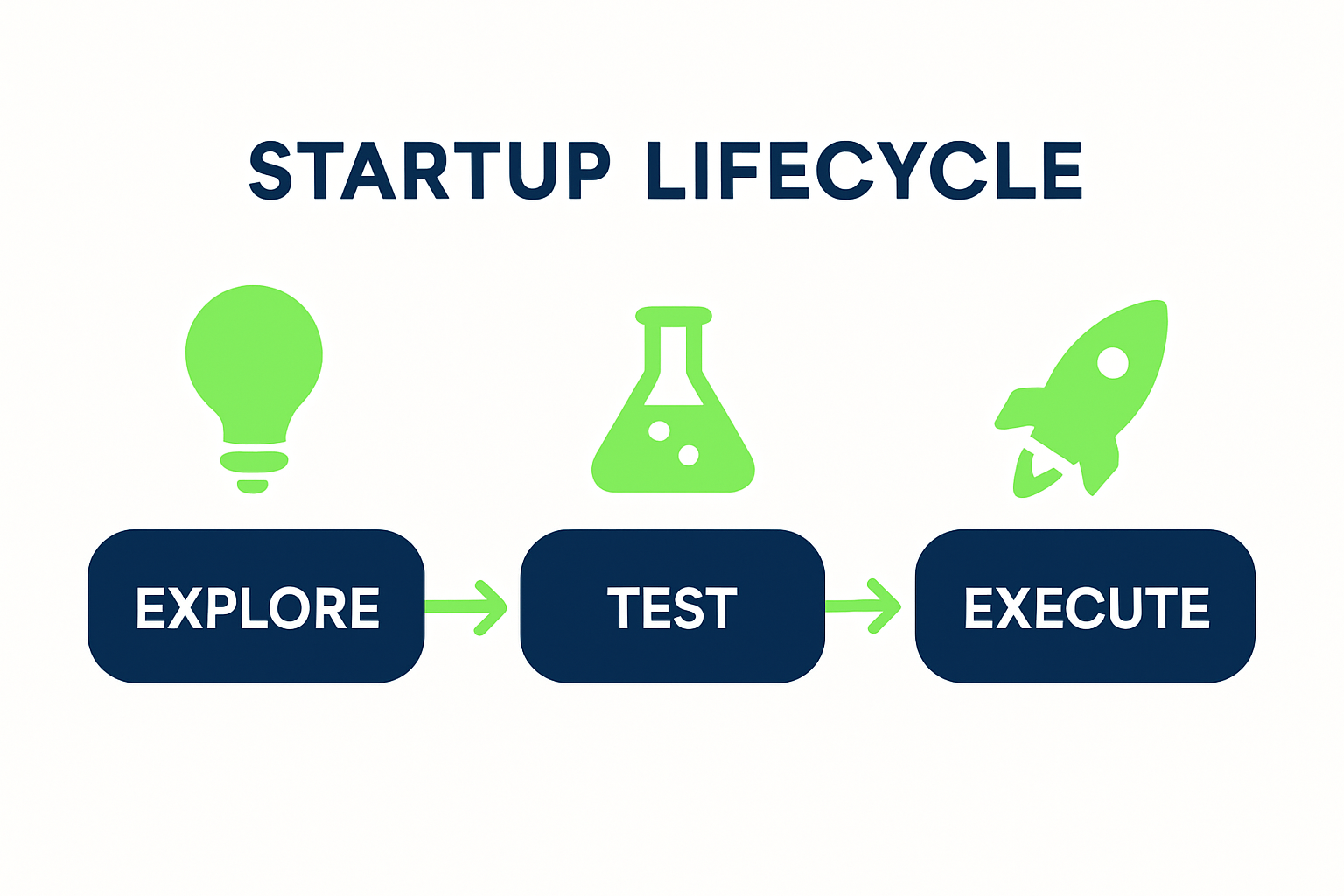
EXPLORE
Customer/Problem Fit
Discover real customer problems worth solving through systematic research and validation. This phase prevents the #1 cause of failure: building something nobody wants.
• Identify target customer segments
• Conduct customer interviews
• Map Jobs-to-be-Done
• Validate problem significance
TEST
Problem/Solution Fit
Build and validate minimum viable products using hypothesis-driven experimentation. This phase ensures your solution actually solves the validated problem before major investment.
• Design MVP experiments
• Build-Measure-Learn cycles
• Test value propositions
• Iterate based on feedback
EXECUTE
Product/Market Fit
Scale your validated solution and achieve sustainable product-market fit. This phase focuses on growth, optimization, and building a repeatable sales process.
• Measure Product-Market Fit
• Optimize growth channels
• Refine positioning & branding
• Scale operations sustainably
Why This Framework Works
- Evidence-based: Every decision is backed by customer data, not assumptions
- Risk-reducing: Validates demand before significant investment in building
- Iterative: Allows for pivots based on learning at each stage
- Proven: Used successfully by companies like Dropbox, Airbnb, and Slack
Test Your Understanding
Introduction & Framework Quiz
What percentage of startups fail because they build products nobody wants?
Your Learning Journey: The Business Model Canvas as Your Guide
Throughout this entire course, you'll be working with one central tool: the Business Model Canvas (BMC). This isn't just another framework to learn—it's your single source of truth that will evolve with you from your first idea all the way to product-market fit.
🎯 Why the BMC is Different
Unlike traditional business plans that sit in a drawer gathering dust, the BMC is a living, breathing document that you'll continuously update based on real customer feedback, validation experiments, and market learnings.
📝 Section 2: Business Model Design
Create your FIRST version based on initial hypotheses
🔍 Section 3: Explore
REFINE your BMC with customer insights and problem validation
🧪 Section 4: Test
UPDATE your BMC using MVP results and validation data
🚀 Section 5: Execute
FINALIZE your BMC with real operations, partnerships, and scaling strategies
💡 Key Principle:
The BMC is NOT a one-time exercise. In every section of this course—from Explore to Test to Execute—you'll be asked to revisit and update your canvas. This iterative approach ensures your business model is always grounded in evidence, not assumptions.